

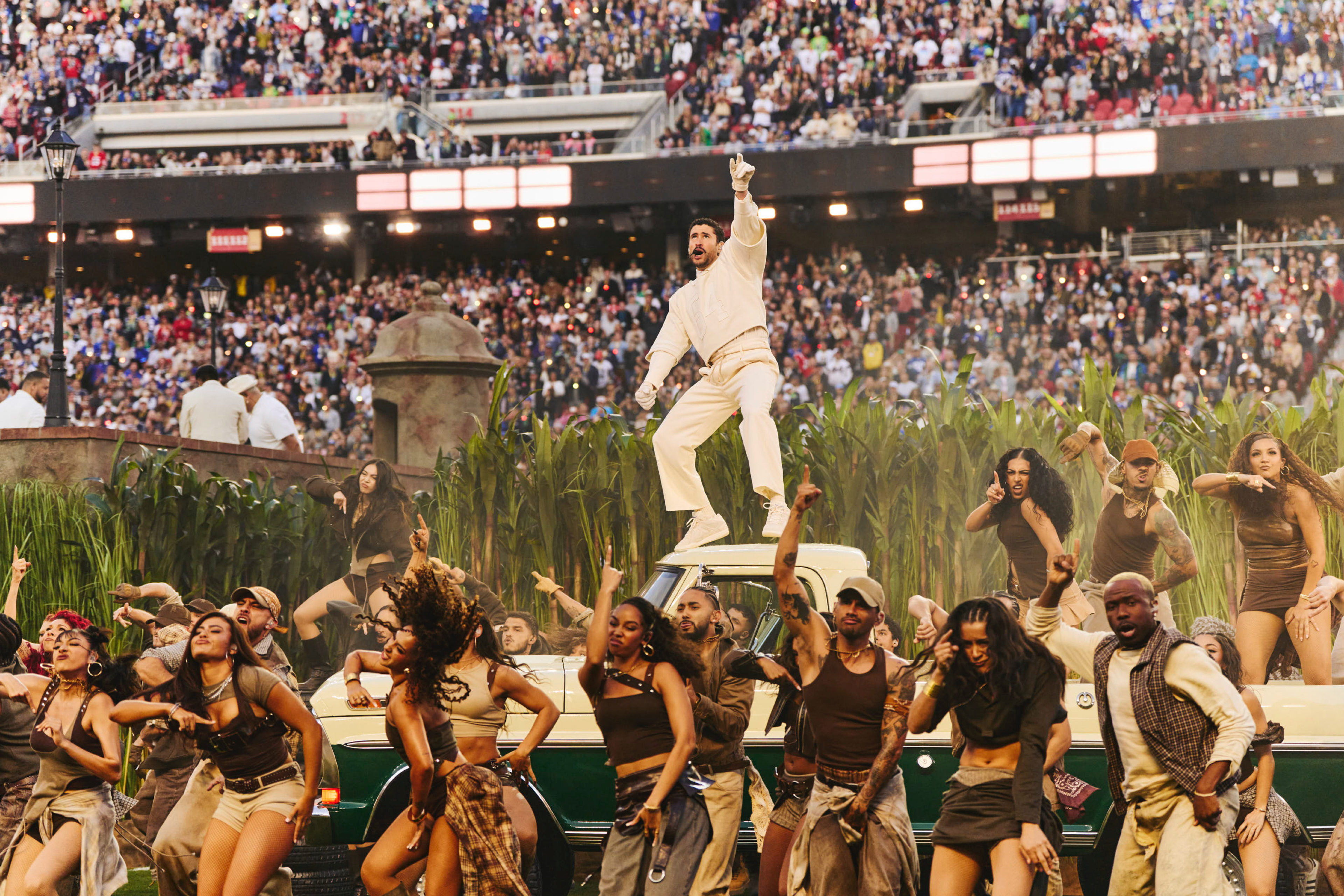
The 2026 Super Bowl halftime show was not just a spectacle. It was a cultural earthquake.
For weeks, young people across the world speculated about what Bad Bunny would do on America’s biggest stage. But no one could have predicted how deeply political, personal, and generational his performance would be. What millions witnessed was not simply a concert — it was a statement about who gets to belong, who gets to be seen, and who gets to define “America”.
Bad Bunny became the first Spanish-speaking superstar to perform an entire Super Bowl halftime show solely in Spanish — a reality that would have seemed impossible just six years ago. Yet there he stood: unapologetic, confident, and electric, leading a global audience in a celebration of Latin culture that felt both intimate and monumental.
For Gen Z and young listeners especially, this moment hit different. Bad Bunny has always been more than music — he is a symbol of self-expression, pride, and resistance. His fans don’t just listen to him; they see themselves in him.
Only days before the Super Bowl, Benito called out ICE and the Trump administration’s immigration crackdown during his Grammy acceptance speech — policies that have torn families apart and disproportionately impacted communities of color. His message was brief but unforgettable: love is stronger than hate. Young people around the world waited to see how he would follow those words.
His response came through art.
Rather than protest in speeches, Bad Bunny turned the halftime stage into a celebration and a reminder of all the South American and Caribbean nations that form part of the diverse mosaic of America — not just the United States. His performance expanded the meaning of “America,” showing that it is a shared, interconnected cultural landscape rather than a single nation.
Many described the show as a love letter to Puerto Rico. It was that — but it was also a soulful reminder to the entire globe that community matters. Patriotism can be beautiful, but only when it’s doors are open to share and be inclusive.
By bringing out icons like Ricky Martin and Lady Gaga, Bad Bunny showed that while roots run deep in cultural pride, all the subcultures within the U.S. together form one larger community. Different histories, languages, and traditions — yet part of the same picture.
The stage design carried history without preaching. Sugar cane fields evoked Puerto Rico’s colonial past. Electric poles symbolized years of neglect and struggle. Yet within that pain was joy: elders playing dominoes, bustling nail salons, children dreaming big — a reflection of Benito’s own journey from a humble neighborhood to global stardom.
Flags from across Latin America and the Caribbean filled the stadium as Bad Bunny passionately shouted their names during DTMF, striding off stage with quiet defiance.
And the world responded. The performance became the most-watched halftime show of all time — proof that young audiences crave authenticity, representation, and truth over empty spectacle.
For many viewers, especially youth, the show felt like more than entertainment. It was validation. It was visibility. It was empowerment.
It was a party. It was nostalgia. It was resistance. It was remembrance.
Bad Bunny didn’t just perform for the crowd — he spoke to a generation that believes identity is fluid, borders are artificial, and culture should be celebrated, not policed.
And so, this is how “the West was won,”. It wasn’t won by power or politics — it was won by music, unity, and love.
Bad Bunny didn’t just headline the Super Bowl.
He reframed America as a vibrant cultural mosaic — and invited the world to dance inside it.